Excel to PDF: Set Print Areas and Page Breaks
This practical guide explains Excel to PDF conversion for spreadsheets and tabular reports. Follow the workflow, check the output and understand when another method is safer.
When is this useful?
Use Excel to PDF conversion when preparing spreadsheets and tabular reports. The operation is designed for this focused job; it is not a replacement for a full document editor.
The sheet should fit the chosen paper size without shrinking important values beyond readability
Step-by-step walkthrough
- Prepare a copy of the source file for Excel to PDF conversion. Confirm the extension and open the original once before using the tool.
- The sheet should fit the chosen paper size without shrinking important values beyond readability
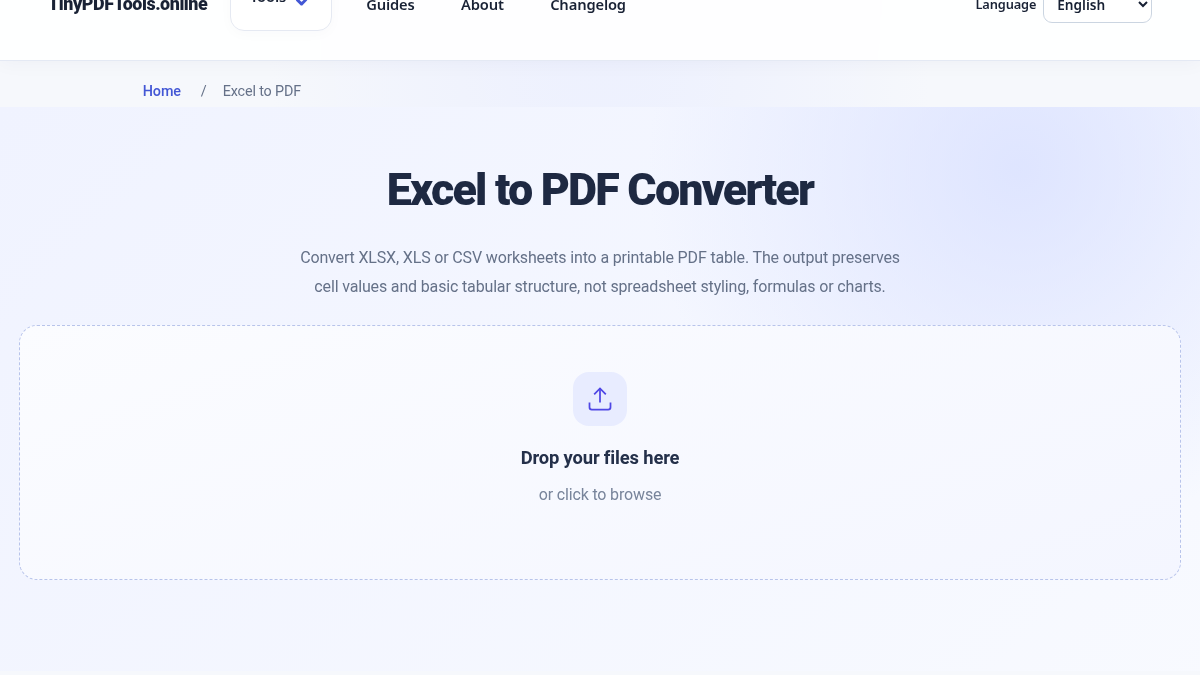
- Choose Excel to PDF, add the workbook and convert it to a PDF copy.
- Open the final file in another app and compare the result with the source. Keep the original until review is complete.
Tool screenshots
What to verify
Review each sheet, print area, scaling, page breaks, formulas, hidden columns and repeated title rows.
Choose Excel to PDF, add the workbook and convert it to a PDF copy.
Choosing the right approach for Excel to PDF: Set Print Areas and Page Breaks
Set the print area, paper size, orientation and scaling in the workbook before exporting. Wide tables may need landscape pages or repeated header rows to remain readable.
Review the PDF page by page for clipped columns, tiny scaling, broken totals and unexpected blank pages.
Limitations
This focused browser tool handles Excel to PDF conversion; it is not a substitute for a full-featured editor. Keep the original and verify the output before relying on it.
Always compare the output with the source and follow the receiving service’s specific requirements.
Frequently asked questions
When should I use another method for excel to pdf?
Use desktop software or the original authoring application when you need advanced controls, batch processing or exact source fidelity.
What are common reasons the workflow fails?
Unsupported source features, damaged files, missing fonts and browser memory limits can affect processing.
How do I know the result is acceptable?
Open the downloaded file in a separate reader and inspect the pages or content that matter most.
Which settings affect the result most?
The source document, page count, embedded images, fonts and selected output settings have the greatest effect.
What should I prepare before excel to pdf?
Keep an untouched copy, confirm the source format and identify any required size, quality or layout constraints.
What is the main goal of Excel to PDF?
The goal is to complete the specific excel to pdf task while preserving the information needed in the final file.
This practical guide explains Excel to PDF conversion for spreadsheets and tabular reports. Follow the workflow, check the output and understand when another method is safer.
Open the tool: Excel to PDF Converter →